
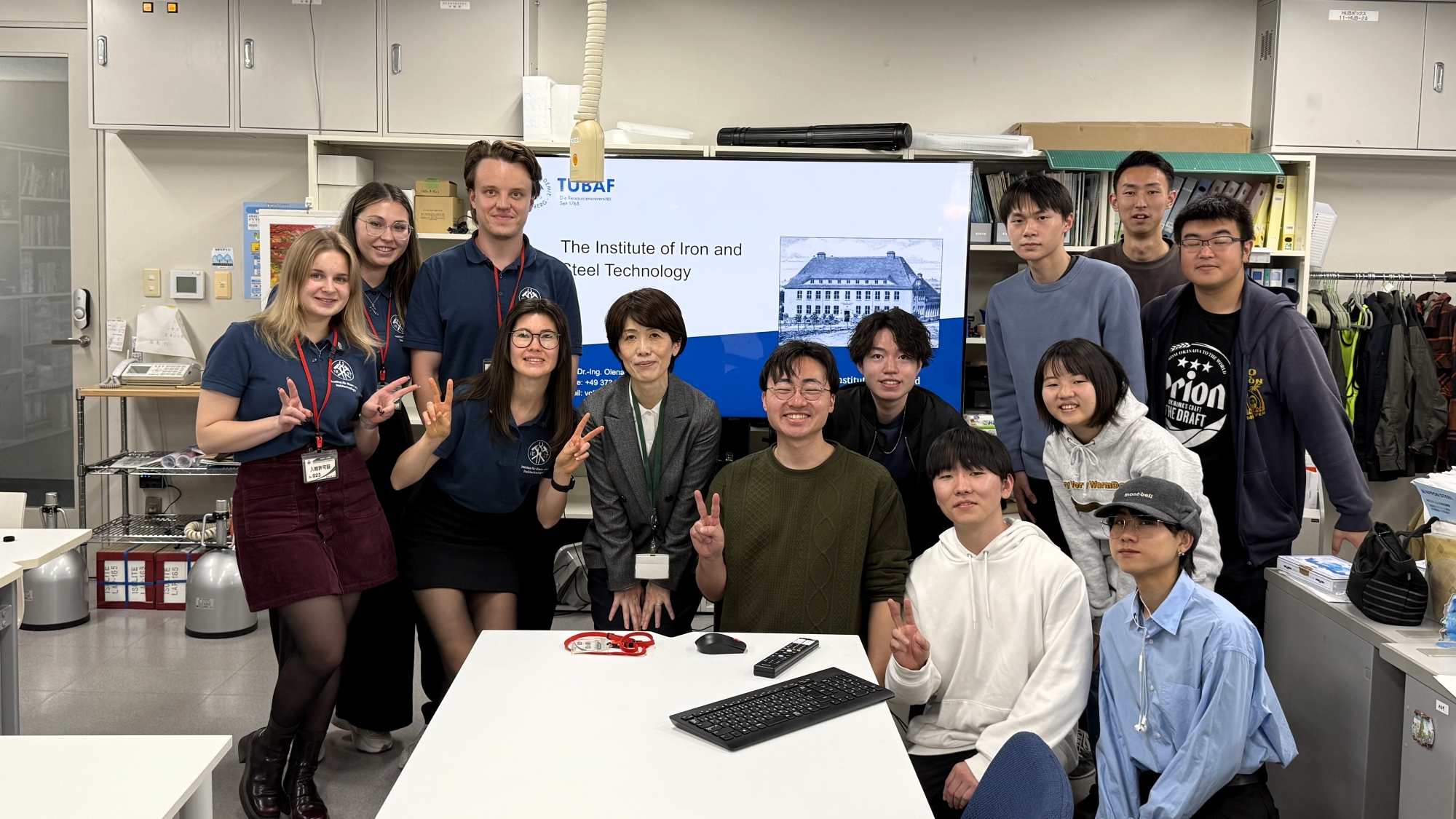
Four doctoral students, four weeks in Japan – Mykyta Levchenko, Galiia Khalimova, Anastasiia Sherstneva and Anhelina Mospan from the Institute of Iron and Steel Technology share their experiences of their research stay in the Land of the Rising Sun.
Intensive scientific exchange and the strengthening of international networks were at the heart of our research stay in Japan. As a delegation of four doctoral students from the Institute of Iron and Steel Technology, we had the opportunity in November to spend four weeks sharing our expertise in modern metallurgy with renowned Japanese partners and gaining new insights. Our research focus lies on iron and steel metallurgy along the entire process chain—from primary and secondary metallurgy to modern powder metallurgical processes. Now more than ever, science and industry face the joint challenge of becoming more resilient and environmentally friendly. One of the most important steps in mastering these tasks is international cooperation under the motto: “Science has no borders”. Our itinerary took us to three outstanding institutions: Ibaraki University in Hitachi, Kyushu University in Fukuoka, and the Shibaura Institute of Technology in Tokyo. At all three locations, we were warmly welcomed and granted access to highly specialized laboratory infrastructure. This enabled us to conduct extensive joint experimental series, the results of which will flow directly into our ongoing doctoral theses.
In addition to practical work in the laboratories, we utilized seminars and lectures to present our individual research results for discussion, while simultaneously showcasing our university as an attractive location for excellent research. Another highlight, extending beyond the university partnerships, was the cultural exchange. Immersing ourselves in a culture so fundamentally different from our own, and having the opportunity to live and work in accordance with Japanese customs and traditions, was a valuable experience. It strengthened our intercultural competence and will help us to encounter people from other cultural backgrounds with greater openness and understanding.
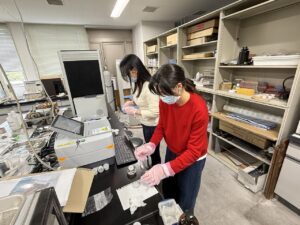
Galiia Khalimova: The stay in Japan was a professional and personal breakthrough. Access to specialized equipment provided crucial data that is vital for my doctorate and significantly advances the optimization of decopperization. The international exchange expanded my scientific horizon and demonstrated the value of cultural diversity. In particular, being recognized as a researcher and building global networks gave me confidence and laid an important foundation for my future.
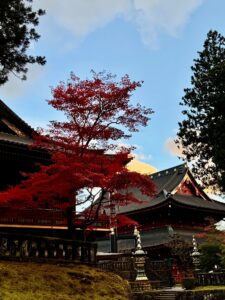
Mykyta Levchenko: From a personal perspective, this research stay in Japan taught me lessons long before I even arrived. Communicating with Japanese professors and planning the travel logistics were already major challenges that helped me improve my organizational skills. Furthermore, through my stay and by conducting experiments in Japanese laboratories, I got to know a completely different world, which naturally had a positive impact on my doctoral thesis and my personal development.
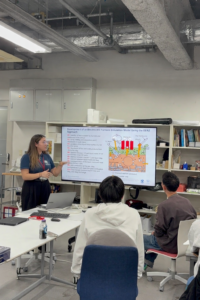
Anhelina Mospan: The research stay in Japan supported my doctorate primarily in a practical sense: I was able to conduct or assist with important experiments in the partner institutions’ laboratories and obtain additional measurement data that will be directly incorporated into my ongoing analysis. The professional exchange on-site helped me to clearly categorize open questions and plan the next work steps in Freiberg more precisely. This was made possible by the internationalization funding of the TU Bergakademie Freiberg.
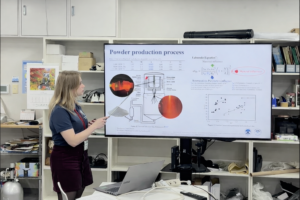
Anastasiia Sherstneva: For me, the research trip to Japan represented the first experience of this magnitude within the framework of my doctorate. It enabled me to carry out important experiments that are not feasible in Freiberg, which is of great significance for my work in the field of powder metallurgy. Additionally, the international exchange showed me that my research topic is relevant worldwide. Through several scientific presentations and discussions with international researchers, I was able to reflect on my results, strengthen my confidence in my own project, and gain valuable experience in leading professional discussions. Overall, the trip made an important contribution to both my dissertation and my personal development as a scientist.