
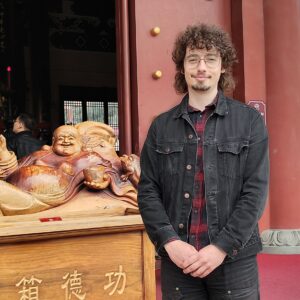
Sebastian Stahl is doing his doctorate at the MSE Lab (Professorship for Measurement, Sensor and Embedded Systems). In October, he spent three weeks at a summer school at the China University of Mining and Technology in Xuzhou.
Your research topic briefly explained: What is it about and what makes it so exciting for you?
I develop fast computer models that can be used to predict how ultrasound waves pass through many different materials. It’s similar to a doctor using an ultrasound device to visualise the inside of our bodies, except that here, tiny components such as chips are examined without having to cut them open. To do this, I use computational methods from the geosciences, which model the propagation of earthquakes, for example. They allow us to efficiently calculate complex layer structures and deliver accurate results in a short time. This could greatly accelerate quality assurance for such chips. What fascinates me about this is that techniques from geoscience, which are designed for a span of kilometres, help to test the smallest millimetre-sized components.
How did your time abroad contribute to your doctoral project?
Participating in the summer school was helpful for my doctoral studies in several ways. There were both thematic lectures and guided tours of testing facilities. Hearing about topics that use similar tools and methods to those in my own work, but in a different context, broadens my understanding of my own activities. This makes it easier to recognise existing comparable approaches or where the same method is used for other purposes. The way Chinese culture values science, university and learning in a social context in general also gave me a new perspective on the workload that comes with a doctorate. Working 10 hours a day, even on weekends, is not unusual. This made me realise how much time and commitment a doctorate can actually require – an aspect that I had previously tended to underestimate. The cultural excursions that took place alongside the lectures, as well as the exchanges with many Chinese students before, during and after the events, were perfect for this.
What did you gain personally?

Living in a Chinese city inland and without much tourism was a bit challenging at first, as I couldn’t speak any Chinese, but I was quickly taken in by the hospitality of the locals. I made many new friends who will certainly be very valuable for my work and also for me personally in the future. I also quickly learned how many chillies you can put in a fish soup and still call it fish soup. In addition, it was particularly interesting to compare the personal prejudices one has about China with reality. For example, I was surprised at how quiet and chaotic the traffic in the big cities is at the same time. It was also a new experience to be able to use a functioning long-distance rail network.